Notebook 07, page 112
Draw the lock. Then cut the key.
Quillon designs small-molecule medicines from the measured shape of their targets, and builds the test that finds the patients each one is for.
Explore the pipelinefig. 1 The chain, in sequence order, before it folds.
fig. 2 The fold. Four helices pack against a four-stranded sheet and leave a pocket.
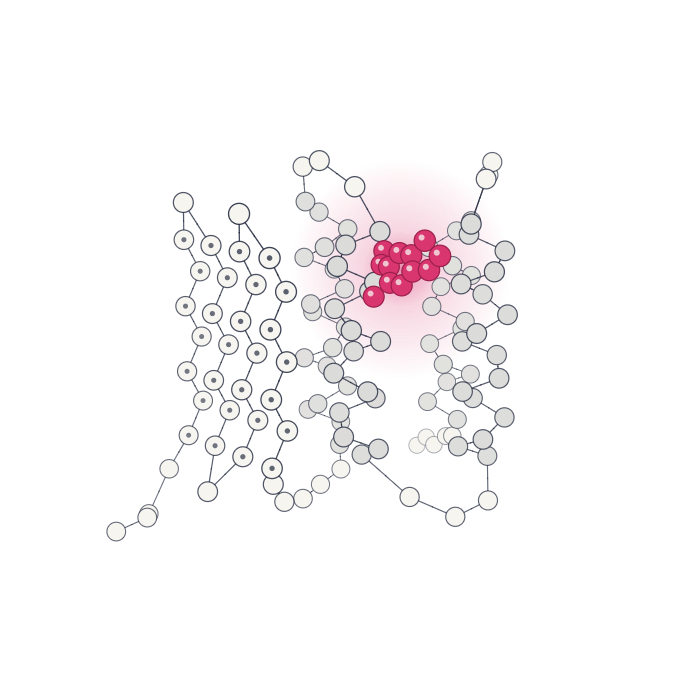
fig. 3 A compound drawn to fit that pocket. Illustrative model, not a real structure.
The idea
A medicine is a shape that fits another shape. We start with the second one.
Before any chemistry, we measure the target: its structure, how it moves, where it can be held. Every compound we make is drawn against that record, and every result goes back into it, including the ones that did not work.
Method
Four entries, in order.
The same four steps run for every programme, and each one leaves a record the next can check.
-
01
Measure
We solve the structure of the target protein by cryo-electron microscopy and crystallography, then watch how it moves in simulation. The output is a map of the places a small molecule could hold.
fig. 4 A sample grid, 3 mm across. -
02
Draw
Medicinal chemists and computational scientists share one desk. They design against the map, score each idea and choose a few dozen worth making. Most ideas end here, which is the point.
fig. 5 Pocket contour, with the ligand pencilled in. -
03
Make and test
Compounds are made and run through binding, cell and safety assays in our own labs. Each plate is planned in the notebook before it runs, and read against that plan after.
fig. 6 Plate map, rows A to F. -
04
Find the patient
From the first programme meeting, a diagnostics team builds the test that picks out who should receive the medicine. The drug and its test move through development together.
fig. 7 Tissue section, marker stain.
Pipeline
The pipeline, as of this page.
Sample data. These programmes are fictional and show how the explorer works. Nothing here describes a real medicine or a real result.
No programme matches those filters.
Partnering
Partner on a programme, or on the method.
- Licensing
- Regional or global rights to a preclinical or clinical programme.
- Co-development
- Shared cost and shared decisions, usually from candidate selection through Phase 2.
- Research collaboration
- Our structural and chemistry platform, pointed at a target you bring.
A business development lead reads every enquiry. Confidential material is exchanged only under a signed disclosure agreement, so please keep this first note non-confidential.
Governance
Who signs the notebook.
Board of directors
- Independent chair
- Chief executive officer
- Chief scientific officer
- Two investor directors
- Independent non-executive director, clinical
Scientific advisory board
- Structural biology
- Medicinal chemistry
- Clinical oncology
- Clinical neurology
- Regulatory science
Names are listed here once appointments are announced.
On the record
- Research records
- Electronic notebook, witnessed and dated
- Negative results
- Written up and kept
- Animal research
- Planned to the 3Rs: replace, reduce, refine
- Publications
- Listed here on acceptance
- Clinical trials
- Linked to public registry entries
“If it isn’t written down, it didn’t happen.”
An old laboratory rule, pinned above every bench.
Careers
We hire people who write things down.
Structural biologists, chemists, assay scientists and diagnostics engineers. Roles are posted here when open.
careers@example.com